Breast Surgery
Nipples in Harmony
with Your Breasts
We thoroughly analyze your needs to create beautiful breasts that perfectly suit your breast proportions.

Harmonious Nipples
Addressing nipple appearance and breastfeeding function together.
Balanced Nipple Shape
for Beauty and Function
TOPCLASS
Inverted Nipple Correction
An inverted nipple turns inward rather than projecting outward. This may be congenital or related to underdevelopment of the breast tissue. Inversion can affect appearance, hygiene and function. Trapped secretions can make cleaning difficult and cause inflammation, pus or odor. Severe cases may lead to mastitis or a breast abscess, making treatment necessary.

Operating Time
30 minutes to 1 hour

Anesthesia
IV sedation

Hospital Stay
Not required

Stitch Removal
After 7-10 days

Follow-Up Visits
2 visits

Recovery Time
The following day
Details may vary with your condition and the surgical technique.
What Is an Ideal Nipple Shape?
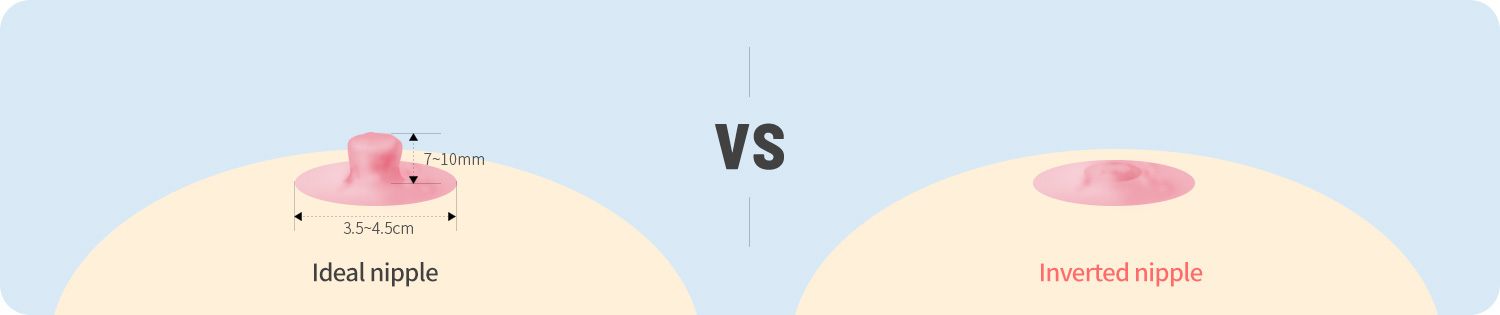
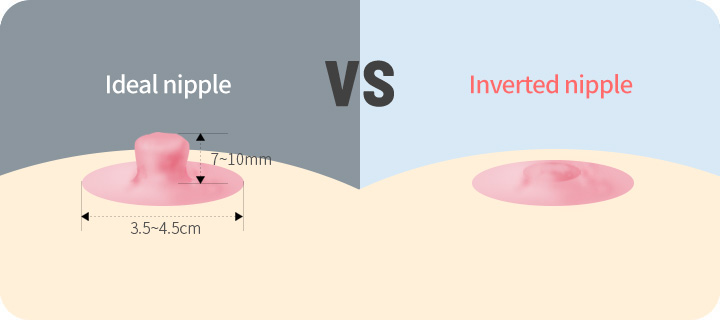
The average areola measures 3.5-4.5 cm across.
Within it, a nipple approximately 1 cm in diameter
and 0.7-1 cm in height is considered an ideal proportion.
Classification by Degree
of Inversion

Inverted Nipples Grade 1
The nipple comes out easily with gentle stimulation
and stays out for a period of time.
SOLUTION
Massage or a correction device may help.
If inversion persists despite these measures,
surgical correction is required.

Inverted Nipples Grade 2
The nipple can be brought out with stimulation,
but quickly retracts.
SOLUTION
Massage or a correction device is unlikely
to provide lasting improvement.
Because recurrence is common, surgical correction is required.
Inverted Nipples Grade 3
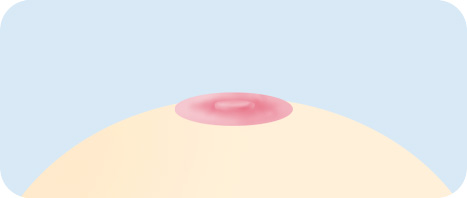
The nipple does not come out with stimulation,
or retracts immediately even if brought out.
SOLUTION
Surgery is generally
the only effective correction.
TOPCLASS
Inverted Nipple Correction Techniques
Purse-String Suture Technique
With the nipple fully drawn outward, a small incision is made beneath it.
A purse-string suture is then placed around its base to hold it in position.

01
Draw the inverted nipple outward,
stretch it and release the fibrous tissue

02
Reinforce the tissue around the milk ducts
with a purse-string suture
to prevent the nipple from retracting

03
Preserve the nipple shape
during closure
Triangular Flap Technique
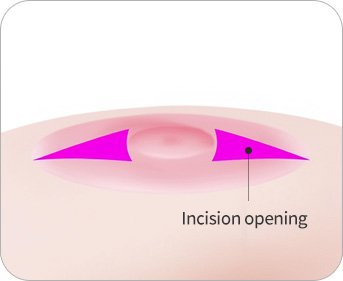
An incision is made around the nipple.
The milk ducts and fibrous tissue are stretched to bring the nipple out without damaging the ducts.
A triangular skin flap then supplies the missing dermal support to maintain the corrected position.
01
Make a small incision at the nipple
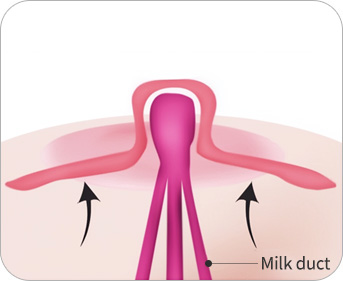
02
Stretch the fibrous ligament tissue
pulling the nipple inward while
preserving the milk ducts
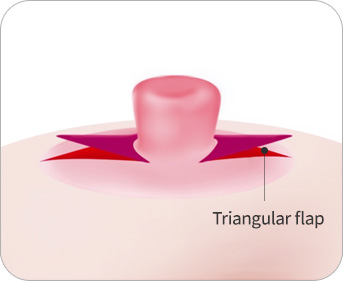
03
Create a triangular flap
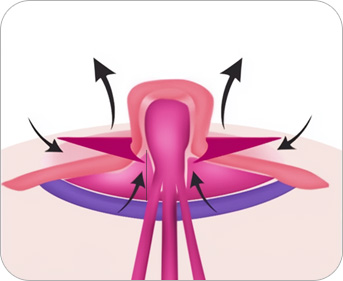
04
Form a tunnel beneath the nipple
and bring the nipple outward
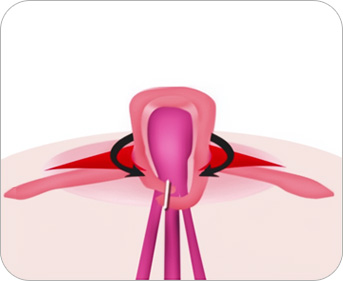
05
Place the flap in the tunnel
beneath the raised nipple,
then suture the ligament tissue to support it
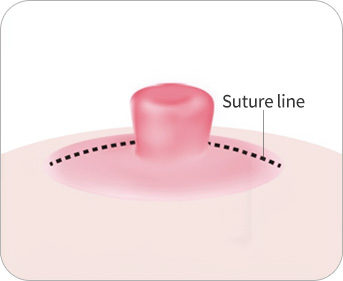
06
Position the flap,
bring the remaining skin together and suture
Duct-Dividing Technique
Shortened milk ducts are divided so the nipple can project outward in its normal shape.
Separating and lengthening the structures responsible for the inversion
provides a pronounced correction with a very low recurrence rate.

01
Bring the inverted nipple outward
and incise both sides

02
Divide the fibrous tissue
pulling the nipple inward

03
Use surrounding tissue to reinforce the base
and prevent renewed inversion

04
Preserve the nipple shape
during closure

Why Do So Many People
Choose TOPCLASS?
Discover the distinctive qualities behind their choice.
Main Phone: +82 2 567 3456
Call us anytime for a friendly consultation.
Clinic Hours
Weekdays
9 : 30 AM ~ 7 : 00 PM
Friday
9 : 30 AM ~ 9 : 00 PM (Evening Hours)
Saturday
9 : 30 AM ~ 4 : 00 PM
* Closed on Sundays and public holidays
Gangnam Station, Exit 11 / Line 2 and Shinbundang Line

Clinic: TOPCLASS Plastic Surgery
5F, Changlim Building, 416 Gangnam-daero, Gangnam-gu, Seoul
Representatives: Yong Hoon Chun, Hyung Joon Kim
Business Registration Number: 220-08-86836
Tel : +82 2 567 3456
email : topclassprs1@gmail.com
COPYRIGHT (C) 2024 TOP CLASS PLASTIC SURGERY.
ALL RIGHTS RESERVED.